Wednesday, May 17, 2017

Tuesday, May 16, 2017
Sunday, May 14, 2017



Mandala gallery

Paradise flower mandala
Distemper paints on paper

Glamour mandala
Distemper paints on paper

Meditation mandala
Distemper paints on paper
Friday, March 31, 2017




Thursday, March 30, 2017

Monday, February 27, 2017

Om
Om
Om ( Auṃ or Oṃ, Sanskrit: ॐ) is a sacred sound and a spiritual icon in Hindu religion. It is also a mantra in Hinduism, Buddhism, Jainism, and Sikhism.
Om is part of the iconography found in ancient and medieval era
manuscripts, temples, monasteries and spiritual retreats in Hinduism,
Buddhism, and Jainism. The symbol has a spiritual meaning in all Indian dharmas, but the meaning and connotations of Om vary between the diverse schools within and across the various traditions.
In Hinduism, Om is one of the most important spiritual symbols (pratima). It refers to Atman (soul, self within) and Brahman (ultimate reality, entirety of the universe, truth, divine, supreme spirit, cosmic principles, knowledge). The syllable is often found at the beginning and the end of chapters in the Vedas, the Upanishads, and other Hindu texts.[11] It is a sacred spiritual incantation made before and during the recitation of spiritual texts, during puja and private prayers, in ceremonies of rites of passages (sanskara) such as weddings, and sometimes during meditative and spiritual activities such as Yoga.


Sunday, February 26, 2017


Saturday, February 25, 2017


Wednesday, December 14, 2016


Friday, December 2, 2016


Wednesday, November 30, 2016


Tibetan mandala
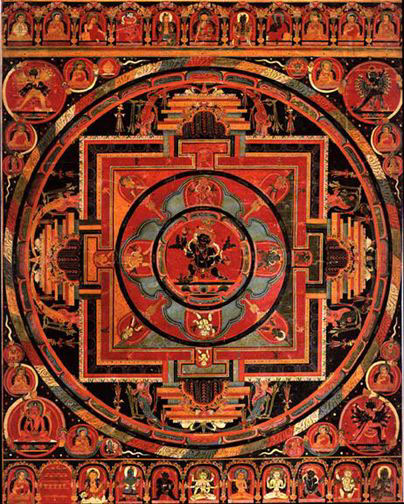
Mandala of an Esoteric Form of Vajrapani
Vajrapani, "he who holds the thunderbolt sceptre," appears at the center
of this mandala in one of his many esoteric forms.1 The three-faced,
four-armed god holds his characteristic thunderbolt sceptre and the
bell, while his other hands grasp the body o
f a serpent, held firm between his teeth and trampled beneath his feet.
His red hair is gathered like a helmet of molded flames, further
adorned with a serpent. A delicate serpent winds about his neck.
The mandala includes in its first circle gods who resemble the central
figure, although they differ in color: white (E), yellow (S), red (W)
and green (N). In the next circle, at the intermediate points of the
compass, are offering goddesses, perhaps the
standard four: Puspa (flowers; NE), Dhupa (incense; SE), Dipa (light,
SW), and Gandha (perfume, NW). There are four guardians of the temple
gates.Outside the mandala proper are esoteric deities in yab-yum ("father-mother"), the posture of sexual embrace; Tibetan teachers (once identified by inscription, now abraded); and the seven jewels of the cakravartin ("universal monarch"): horse, wish-fulfill ing gem (here, probably the triratna or "three jewels of Buddhism" representing the Buddha, the Buddhist doctrine and the monastic community), the elephant, the wheel of the Buddhist law, a general (figure with shield), queen, and a minister who holds tre asure in his hands (here, the god of wealth, Jambhala).2 In the top register is a lineage of mortal and celestial teachers associated with Vajrapani's teachings. The bottom register includes a monk seated before offerings, deities, and protectors of the faith.

Subscribe to:
Posts (Atom)