Monday, February 27, 2017


Om
Om
Om ( Auṃ or Oṃ, Sanskrit: ॐ) is a sacred sound and a spiritual icon in Hindu religion. It is also a mantra in Hinduism, Buddhism, Jainism, and Sikhism.
Om is part of the iconography found in ancient and medieval era
manuscripts, temples, monasteries and spiritual retreats in Hinduism,
Buddhism, and Jainism. The symbol has a spiritual meaning in all Indian dharmas, but the meaning and connotations of Om vary between the diverse schools within and across the various traditions.
In Hinduism, Om is one of the most important spiritual symbols (pratima). It refers to Atman (soul, self within) and Brahman (ultimate reality, entirety of the universe, truth, divine, supreme spirit, cosmic principles, knowledge). The syllable is often found at the beginning and the end of chapters in the Vedas, the Upanishads, and other Hindu texts.[11] It is a sacred spiritual incantation made before and during the recitation of spiritual texts, during puja and private prayers, in ceremonies of rites of passages (sanskara) such as weddings, and sometimes during meditative and spiritual activities such as Yoga.


Sunday, February 26, 2017


Saturday, February 25, 2017


Wednesday, December 14, 2016


Friday, December 2, 2016


Wednesday, November 30, 2016


Tibetan mandala
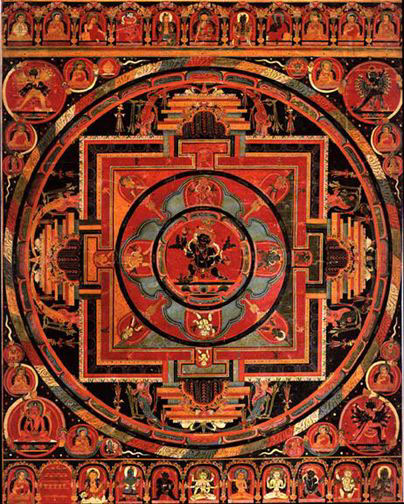
Mandala of an Esoteric Form of Vajrapani
Vajrapani, "he who holds the thunderbolt sceptre," appears at the center
of this mandala in one of his many esoteric forms.1 The three-faced,
four-armed god holds his characteristic thunderbolt sceptre and the
bell, while his other hands grasp the body o
f a serpent, held firm between his teeth and trampled beneath his feet.
His red hair is gathered like a helmet of molded flames, further
adorned with a serpent. A delicate serpent winds about his neck.
The mandala includes in its first circle gods who resemble the central
figure, although they differ in color: white (E), yellow (S), red (W)
and green (N). In the next circle, at the intermediate points of the
compass, are offering goddesses, perhaps the
standard four: Puspa (flowers; NE), Dhupa (incense; SE), Dipa (light,
SW), and Gandha (perfume, NW). There are four guardians of the temple
gates.Outside the mandala proper are esoteric deities in yab-yum ("father-mother"), the posture of sexual embrace; Tibetan teachers (once identified by inscription, now abraded); and the seven jewels of the cakravartin ("universal monarch"): horse, wish-fulfill ing gem (here, probably the triratna or "three jewels of Buddhism" representing the Buddha, the Buddhist doctrine and the monastic community), the elephant, the wheel of the Buddhist law, a general (figure with shield), queen, and a minister who holds tre asure in his hands (here, the god of wealth, Jambhala).2 In the top register is a lineage of mortal and celestial teachers associated with Vajrapani's teachings. The bottom register includes a monk seated before offerings, deities, and protectors of the faith.

Sunday, November 27, 2016


Friday, September 2, 2016


Tuesday, July 5, 2016
Symbolism of owl
Symbolism of owl
Denotes wisdom, a
symbol of knowledge, heightened observational skills, introspective,
brooding, can see in the dark, developed awareness, high spiritual
enlightenment It can also mean to use more judgment in a life
situation. In the negative, it represents nocturnal "furtive'
habits, solitude, silent flight, a plaintive 'harbinger of death'
cry, and symbolize a turning away from spiritual light. In China the
owl is a harbinger of misfortune, but it is the sacred animal of the
rain-god it symbolizes a demonic nightcreature and considered an evil
omen.


Sunday, July 3, 2016
Neptune
Neptune
Neptune is not visible to the unaided eye and is the only planet in the Solar System found by mathematical prediction rather than by empirical observation. Unexpected changes in the orbit of Uranus led Alexis Bouvard to deduce that its orbit was subject to gravitational perturbation by an unknown planet. Neptune was subsequently observed with a telescope on 23 September 1846 by Johann Galle within a degree of the position predicted by Urbain Le Verrier. Its largest moon, Triton, was discovered shortly thereafter, though none of the planet's remaining known 14 moons were located telescopically until the 20th century. The planet's distance from Earth gives it a very small apparent size, making it challenging to study with Earth-based telescopes. Neptune was visited by Voyager 2, when it flew by the planet on 25 August 1989. The advent of the Hubble Space Telescope and large ground-based telescopes with adaptive optics has recently allowed for additional detailed observations from afar.
Neptune is similar in composition to Uranus, and both have compositions that differ from those of the larger gas giants, Jupiter and Saturn. Like Jupiter and Saturn, Neptune's atmosphere is composed primarily of hydrogen and helium, along with traces of hydrocarbons and possibly nitrogen, but contains a higher proportion of "ices" such as water, ammonia, and methane. However, its interior, like that of Uranus, is primarily composed of ices and rock, and hence Uranus and Neptune are normally considered "ice giants" to emphasise this distinction. Traces of methane in the outermost regions in part account for the planet's blue appearance.
In contrast to the hazy, relatively featureless atmosphere of Uranus, Neptune's atmosphere has active and visible weather patterns. For example, at the time of the Voyager 2 flyby in 1989, the planet's southern hemisphere had a Great Dark Spot comparable to the Great Red Spot on Jupiter. These weather patterns are driven by the strongest sustained winds of any planet in the Solar System, with recorded wind speeds as high as 2,100 kilometres per hour (580 m/s; 1,300 mph). Because of its great distance from the Sun, Neptune's outer atmosphere is one of the coldest places in the Solar System, with temperatures at its cloud tops approaching 55 K (−218 °C). Temperatures at the planet's centre are approximately 5,400 K (5,100 °C).[15][16] Neptune has a faint and fragmented ring system (labelled "arcs"), which was first detected during the 1960s and confirmed by Voyager 2.

Mandala painting

Forest flower mandala
Distemper paints on paper
“The basic difference between an ordinary man and a warrior is that a
warrior takes everything as a challenge while an ordinary man takes
everything as a blessing or a curse.”
― Carlos Castaneda
― Carlos Castaneda


Friday, July 1, 2016
Subscribe to:
Posts (Atom)