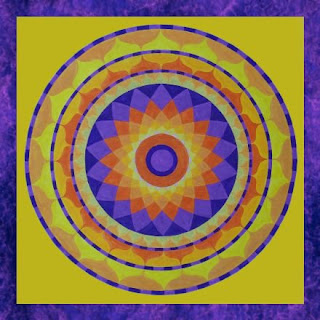
Saturday, July 28, 2012

Mandala paintings, gallery nine


Rainbow Mandala
 It is an acrylic painting. Rainbow is a symbol of heavenly glory and of celestial wonder. It serve as a bridge between earth and paradise.
30 x 30 cm


Night Mandala 
Acrylic on paper. Night Mandala is connected with dreams, intuition and imagination.
21 x 21 cm

Mandala paintings, gallery eight


Lavander Mandala
This Mandala is an acrylic painting. Inspired with lavanda flower.
21 x 21 cm


Golden wheel Mandala
Acrylic on paper. 
29 x 29 cm

Mandala paintings, gallery seven


Blue Mandala
Blue Mandala is an acrylic painting.

 
 Orange flower Mandala
Orange governs the Sacral Chakra situated in the lower abdomen. Acrylic on paper. 

Saturday, July 21, 2012

Mandala paintings, gallery six


 Green flower Mandala
Green color relates to love. Acrylic on paper.


Pink flower Mandala
Acrylic on paper. 
21 x 21 cm


Violet water Zendala
Inspired with amethyst crystal and water. This Zendala is an acrylic painting.
29 x 29 cm


 Gaudy flower Mandala 
Acrylic on paper. Flower is parable for inner harmony. 


Mandala paintings, gallery five


Second Chakra Mandala
This Mandala expresses Second Chakra. It is related  to element water and emotions. Acrylic on paper.
29 x 29 cm


Garden of silence Mandala
Acrylic on paper.


First Chakra Mandala
Expresses First Chakra or Muladhara. This Chakra forms our foundation. Acrylic painting. 
29 x 29 cm


Mystical flower Mandala 
Acrylic on paper.

Mandala paintings, gallery four


Abstract lotus Mandala
Acrylic painting, 29 x 29cm


Amethyst Mandala
Acrylic painting


Aurora Borealis Mandala
Acrylic painting, 29 x 29 cm

Blue dream Mandala
Acrylic painting

Mandala paintings, gallery three


Dragonfly dream Mandala
Acrylic painting, 24,5 x 24,5 cm


Ethno Mandala
Acrylic painting, 29 x 29 cm


Green dream Mandala
Acrylic painting

Mandala paintings, gallery two


Green moon Mandala
Acrylic painting, 29 x 29 cm


Lace Mandala
Acrylic painting, 21 x 21 cm


Night lily Mandala
Acrylic painting, 29 x 29 cm


Pink wheel Mandala
Acrylic painting, 29 x 29 cm

Mandala paintings, gallery one


Purple flower Mandala
Acrylic painting, 29 x 29 cm


Sun flower Mandala
Acrylic painting, 24,4 x 24,5 cm

Tuesday, July 17, 2012

Ornament Mandala


Ornament Mandala

Acrylic on paper

Mandalas in Nature


Mandalas in Nature


Mandala designs in nature can be found in something as simple as a flower. The flower has a center and surrounding that center are beautiful petals. The inside structure of a snail's shell is a spiral that twists into the center. Even the rings found inside tree trunks can be looked upon as a mandala, as each ring graduates toward the center. 

Our solar system can be considered a mandala form as each planet is part of and revolves around a center planet. For example the Milky Way galaxy our solar system holds within it our Earth.  Even microscopic cells each have a center or nucleus. The wholeness created in anything with a center that then radiates outward and inward is the basis of the mandala structure. 


Mandala - The Sacred Circle


Mandala - The Sacred Circle


When entering the realm of inner vision,
We must create a threefold sacred circle,
Composed of purity, of strength and knowledge
Surrounding us like a protective wall.
The purity of heart creates the lotus-circle;
The admantine scepters form the second ring:
The power-circle of determined will and higher aims;
The third one is the ring of wisdom-flames.
The threefold magic circle thus unfolded,
Grows with the depth of heart´s vibration,
Grows with the strength of inner penetration,
Grows with the wisdom that knows life and death.
But only when this world becomes a magic circle,
In which each point can be a living center:
Then we surmount the cause of all illusion,
The riddles of rebirth, of death and dissolution.
Then nothing remains rigid, self-contained;
No point coagulates into a finite "I",
Each being in the others is enshrined,
And in the smallest lives infinity.
Then we shall see released to higher norm
This world as essence of the highest mind,
Which, formless though, creates and moves all form,
Inspires and transmutes it, ever unconfined.

Lama Anagarika Govinda


Tibetan Mandala

Ethno Mandala


Ethno Mandala


Ethno Mandala is an original acrylic painting with crystals. Size is 29 x 29 cm. It is inspired with blue and purple flowers.

Purple color relates to self knowledge/spiritual awareness. It is the union with your higher self, with spirituality, and your higher consciousness. The purple energy connects us to our spiritual self bringing guidance, wisdom and inner strength and purifies our thoughts and feelings giving us inspiration in all undertakings. Enhances artistic talent and creativity.


Third Chakra - Manipura Chakra


Manipura Chakra


   Earth, water, fire. With our bodies grounded and our emotions flowing, we now move on to power, energy and will. This is our third chakra, a yellow lotus of ten petals, located at the solar plexus—the place where we get those butterfly feelings when we feel scared or powerless. Its element is fire—fire—that radiates and transforms matter into energy, giving light and warmth. This chakra represents our "get up and go," our action, our will, our vitality, and our sense of personal power. Its name, Manipura, means "lustrous gem." We can think of it as a glowing yellow Sun, radiating through the center of our body. On the physical plane, the third chakra rules metabolism, the process whereby we turn food (matter) into energy and action. Digestion troubles, stomach troubles, hypoglycemia, diabetes, ulcers, or addictions to stimulants (such as caffeine) are all related to malfunctioning of the third chakra. Weight problems may also be an indication that the body is not properly turning its matter into energy. We can also assess the health of this chakra by examining our body structure at this level: tight, hard stomachs, sunken diaphragms, or large potbellies are all indications of third chakra excess or deficiency. Examining your relationship to the properties of fire can give further clues to the nature of your third chakra. Are you frequently cold, physically or emotionally? Do you get overheated, hot-tempered? Is your style quick and energetic, or slow and lethargic? When the third chakra is closed down, one may feel tired, afraid, shaky, quiet, or withdrawn. There is a fear of taking risks, confronting people or issues, taking charge, and with all this, a lack of energy. There may be too much seriousness and not enough laughter, ease, or fun, all of which help the third chakra open and relax. Pleasure, from the chakra below, helps make the fire warm and easy; without it, our fires are cold and hard. If the chakra is too open, then we have a kind of bully archetype—someone who always needs to be in control, to dominate, to seek power, prestige, ambition. As the lower chakras in general are more ego-oriented, third chakra excess can make a person narcissistic or self-centered. An appropriate concept for a healthy balance in this chakra is the archetype of the warrior—standing strong, staying in touch with feelings, confronting only when appropriate and quietly maintaining a sense of power. A healthy third chakra can take on a task and complete it, take on a risk and not be bound by perfectionism, or act in the role of leadership without domination or self-aggrandizement. In the second chakra we encountered desire. Desire is the fuel for the will, the passion within our body giving strength to decisions made by the mind. Fire is the spark of life that ignites will to action. Fire is the spark that lies between the poles, and the third chakra creates power by combining the polarity introduced by the second chakra, just as electricity is made by the combination of polarities. Having made yet another step toward consciousness, we now temper our desires and instincts with knowledge, making decisions that are then put into action, again combining the poles of mind and body. Power, then, is seen as an act of combination, of joining together parts to make a greater whole. When we embrace and combine all the parts within us—our bodies, our emotions, our visions, our knowledge—then we emerge whole and powerful. A good rule of thumb for stimulating the third chakra is to get your energy moving. Jogging, yelling, or pounding a pillow can help you loosen up.


Manipura Chakra Mandala

Meaning of Red color


Muladhara Chakra Mandala

Red symbolizes:

action, confidence, courage, vitality
  
Red Energy: 

Red is the color of physical energy, passion, and desire. 
It symbolizes action, confidence and courage.
Determination to go after your dreams and the power to achieve goals.
Red demands attention!
Boosts mental and physical energy.
Red is associated with passionate love, sex, great energy, impulse, adventure.
Bold and dynamic, confident and in control.
Willing to take risks.
Ambition and drive with a need for personal freedom.
The color red brings passion and strength to your relationships, your life and your work.
Red is powerfully linked to our most primitive physical, financial, and emotional needs of survival and self-preservation.

Meaning of Red Key Words:  

excitement, energy, heat, love, determination, strength, power, confidence, action, passion, sex, impulse, desire, daring, fire, vigorous, enthusiasm, energetic, honest, devotion, protection, responsible, assertive, adventure, spontaneous, health, extroverted, good fortune, assertiveness and aggression, strong-willed, all things intense and passionate.

Red Words:

These words are synonymous with red or represent various shades of the color red: scarlet, crimson, vermillion, carmine, maroon, burgundy, ruby, rose, madder, rouge, brick, blood red, blush, fire engine red, cinnabar, russet, rust, Venetian red, flame, Indian red, tomato.

Red Gemstones: 

Agate, Bloodstone, Garnet, Hematite, Red Coral, Red Jasper

Red in Feng Shui:

Yang, Fire Element, Red is the color of life, luck, prosperity, power, strength, respect, recognition, energy, activity, glory, and vitality. Red is most active of all colors and is used many ways in Feng Shui.

Chakra associated with Red:

Base or Root Chakra: connects us to our physical self.
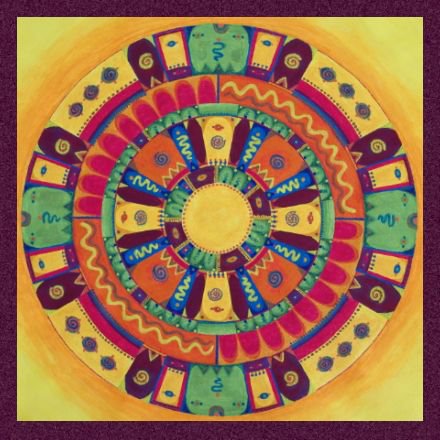
   

Abstract lotus Mandala


 Abstract lotus Mandala
Acryl on paper, 29 x 29 cm 

   Lotuses are symbols of purity and 'spontaneous' generation and hence symbolize divine birth. According to the Lalitavistara, 'the spirit of the best of men is spotless, like the new lotus in the [muddy] water which does not adhere to it', and, according to esoteric Buddhism, the heart of the beings is like an unopened lotus: when the virtues of the Buddha develop therein the lotus blossoms. This is why the Buddha sits on a lotus in bloom. 


Friday, July 13, 2012

Free Mandala


Free Mandala


You can download and print this Mandala pattern, to increase your energy and concentration. By coloring it, you will find balance.

Wednesday, July 11, 2012

Native butterfly Mandala


Native butterfly Mandala


   Native butterfly Mandala is an acrylic painting with crystals. I have painted this Mandala recently and I have used some new details and new patterns.

   The butterfly is a symbol of transformation because of its impressive process of metamorphosis.

Mandalas From Tibet


Tibetan Mandalas


     The Tibetan Monks are most famous for creating mandalas from colored sand. Monks study for about three years to learn all the symbols to be used in creation of a mandala. They learn the geometric shapes to be used and strive to become one with their work as they add sand to the creation. In most cases, four monks create four sections of the mandala each, with a helper that colors in the outlines they make in the mandala. The eight must work as one person and that is the beauty of creating the mandala in the first place.
    It is interesting to know that after spending weeks and weeks making the Tibetan sand mandalas a broom is taken to the creation and the sand is collected and taken to the nearest body of water. It released into the water so that all that use the water will benefit from the blessings of the mandala. Think of the mentality of those monks that created the masterpiece only to have it brushed away. This would truly take a feat of selflessness.
    There are a set of plans and instructions for creating mandalas within each spiritual entity. There are set symbols and set rituals for creating the symbols. There is often a set order in which to place the symbols. Constructing a mandala is sometimes painstakingly intense, yet that is the beauty of creating one.


What is mandala?


  What is mandala? Mandala is `circle´ in the Sanskrit language, and mandala art refers to symbols that are drawn, sketched or painted in a circular frame. Mandala art has been used throughout the world as a process of self-expression, in the service of personal growth and spiritual transformation. Tibetan Buddhism has employed mandala art for thousands of years to capture the images of gods which it believes. Navajo sand painters use them in their healing rites. Many native people use the Medicine Wheel, a mandala form, to connect to earth energies and the wisdom of nature.

  Mandalas are designs that take the form of a circle symbolizing the notion that life is never ending. Many mandalas have spiritual significance to an individual or group of individuals and some times they are used in rituals. The Hindus were one of the first people to use a mandala as a spiritual tool and this was long ago but the mandalas most are familiar with are the ones made by Buddhists.
    Many times mandalas are used for meditation purposes so that the individual meditating can become one with the universe. There are not many that can achieve this state of mind just from studying a mandala. The symbolism behind the creation of a mandala can have significant meaning for all people whether they are Buddhist, Jewish, Christian, Pagan, or any other religion.
    They can be created by an individual to symbolize their journey through life. Mandalas can also tell the story of where the person has been and many times will relate to that person where they should go in life through their own personal revelation. A group can create a mandala that will reveal what they should be doing in order to grow and develop as a group.

Monday, July 9, 2012

Violet wheel Mandala


Violet wheel Mandala


   Violet wheel Mandala is an original acrylic painting with crystals. Size is 29 x 29 cm. It represents inner change.

   The wheel's motion is a metaphor for the rapid spiritual change engendered by the teachings of the Buddha: the Buddha's first discourse at the Deer Park in Sarnath is known as the "first turning of the wheel of dharma." His subsequent discourses at Rajgir and Shravasti are known as the "second and third turnings of the wheel of dharma." The eight spokes of the wheel symbolize the Noble Eightfold Path set out by the Buddha in his teachings.